Virtute Parta

Virtute Parta

Thursday, 6 November 2014

Remains of WWI Canadian Soldier Identified : Pte Sidney Halliday

Pte. Sidney Halliday

Pte. Sidney Halliday (Photo from The Department of National Defence)

The Department of National Defence and the Canadian Forces have identified the remains of a soldier who fought for Canada during the First World War.
In a statement released on Wednesday, the Department of National Defence announced that it had identified the remains to be those of Pte. Sidney Halliday of the 78th Battalion, also known as the Winnipeg Grenadiers.
Born in England, Halliday moved to Manitoba in 1915 and later joined the Grenadiers. He died overseas at the young age of 22, the department said.
Halliday is among eight soldiers whose remains were discovered in 2006 and 2007 in the village of Hallu, located in the northern Somme Region of France.
The discovery of the remains was the largest find of unknown Canadian soldiers since the Canadian Forces began its Casualty Identification Program. All of the remains are believed to be of soldiers who fought with the 78th Battalion.
In September, the department announced that the remains of four of those soldiers had been identified as Lt. Clifford Neelands, Lance- Sgt. John Lindell, Pte. Lachlan McKinnon and Pte. William Simms.
The department said it will be working with the Commonwealth War Graves Commission, along with the relatives of the soldiers to plan for an interment ceremony.
During the war, the Winnipeg Grenadiers were sent to relieve the 3rd Division in the Canadian lines after the first attack of the Battle of Amiens on Aug. 8, 1918.
On Aug. 10, 1918, the Grenadiers were ordered to capture the village of Hallu. During their advance, 26 soldiers from the battalion were killed and 54 soldiers went "missing." Of those 54 soldiers, thirty remain "missing" with no known grave, according to the department.
The department estimates that of the nearly 68,000 Canadian soldiers who died during the First World War, more than 19,000 have no known grave.


Sunday, 2 November 2014

WORLD WAR I MEMORIALS


Lance Corporal William Halliday

FIRST WORLD WAR


Lance Corporal William Halliday, 17th Battalion, Highland Light Infantry. He was killed in action in France on 7th August 1916 during the Battle of the Somme and is buried in Cambrin Churchyard Extension, Cambrin, France

SurnameHALLIDAY
ForenameWilliam
RankL Cpl
Service number23019
Decoration
Place of birthLauder
Date of death8 August 1916
Theatre of deathF&F
Cause of deathKilled in action
SNWM rollTHE HIGHLAND LIGHT INFANTRY
Unit nameUnknown Unit attached to THE HIGHLAND LIGHT INFANTRY
Other detail17th Bn.

WORLD WAR I MEMORIALS


Second Lieutenant John Halliday

FIRST WORLD WAR


Second Lieutenant John Halliday, 2nd Battalion, West Yorkshire Regiment. He was killed in action on 8th May 1918, aged 26. He was the son of John and Catherine Halliday of Eccles Mains, Kelso and is commemorated on the Loos Memorial, Dud Corner, Loos, France. 

Halliday One Name Study


HALLIDAY ONE NAME STUDY


Good news to report. I've adopted the 'Halliday One Name Study' which is a member of the Guild of One Name Studies. I think I originally registered the project in the late 1990's, but due to a young family and other restraints on time, I handed it over to Liz Holliday, who since then has continued to gather information about the surname and variants.

Liz is based in the south of England and has gathered digital and hard copy records for our name, especially from England and Wales statutory records and Wills. The majority of my existing records are for the Scottish Halliday/ Holliday clan members and these were gathered before the days of internet access and ScotlandsPeople.

Over the next few Mondays until Christmas, I intend to visit the ScotlandsPeople Centre in Edinburgh and extract and collate birth, marriage and death indexes with additional information to get the data base underway. 

I'm still trying to decide the best format for working with this data :  Custodian 4, Brothers Keeper, spread sheets, data base, paper etc and how to display research in a user friendly format.

Anyway I hope to start using this blog again to keep you posted with developments. And many thanks again to Liz for all her hard work with the project over the last ten or more years. This is a project with no vestige of a beginning - no prospect of an end.

Saturday, 14 July 2012

Halliday v Holliday : American Lawyer Stripped of Heraldic Arms

Following five years of legal wrangling the matriculation of Arms to an American lawyer who also claimed to reside at Corehead Tower has been 'expunged' from the records. A summary of events was published in the Moffat News -13 July 2012.


Saturday, 19 November 2011

Update on Corehead Archaeology Dig

Tomorrow is the third day of the dig to locate Corehead tower. So far we have dug five test pits in the vicinity of the plantation behind the current Corehead farmhouse.
View towards the Devil's Beef Tub
The first weekend was spent walking the land in the wood looking for possible clues and identifying the rectangular earthwork that was visible on a 1951 aerial photograph, prior to the planting of the wood. Two pits were started in the earthwork and after the removal of earth and smaller stones,larger stones were discovered deliberately placed on top of each other.
It is difficult to say at this stage if they are the foundations of a building or an earlier stone dyke.
Pit 1

Last weekend three pits were dug just outside the wood on a green mound which appears to have the shape of a building.

'Quarry' site 

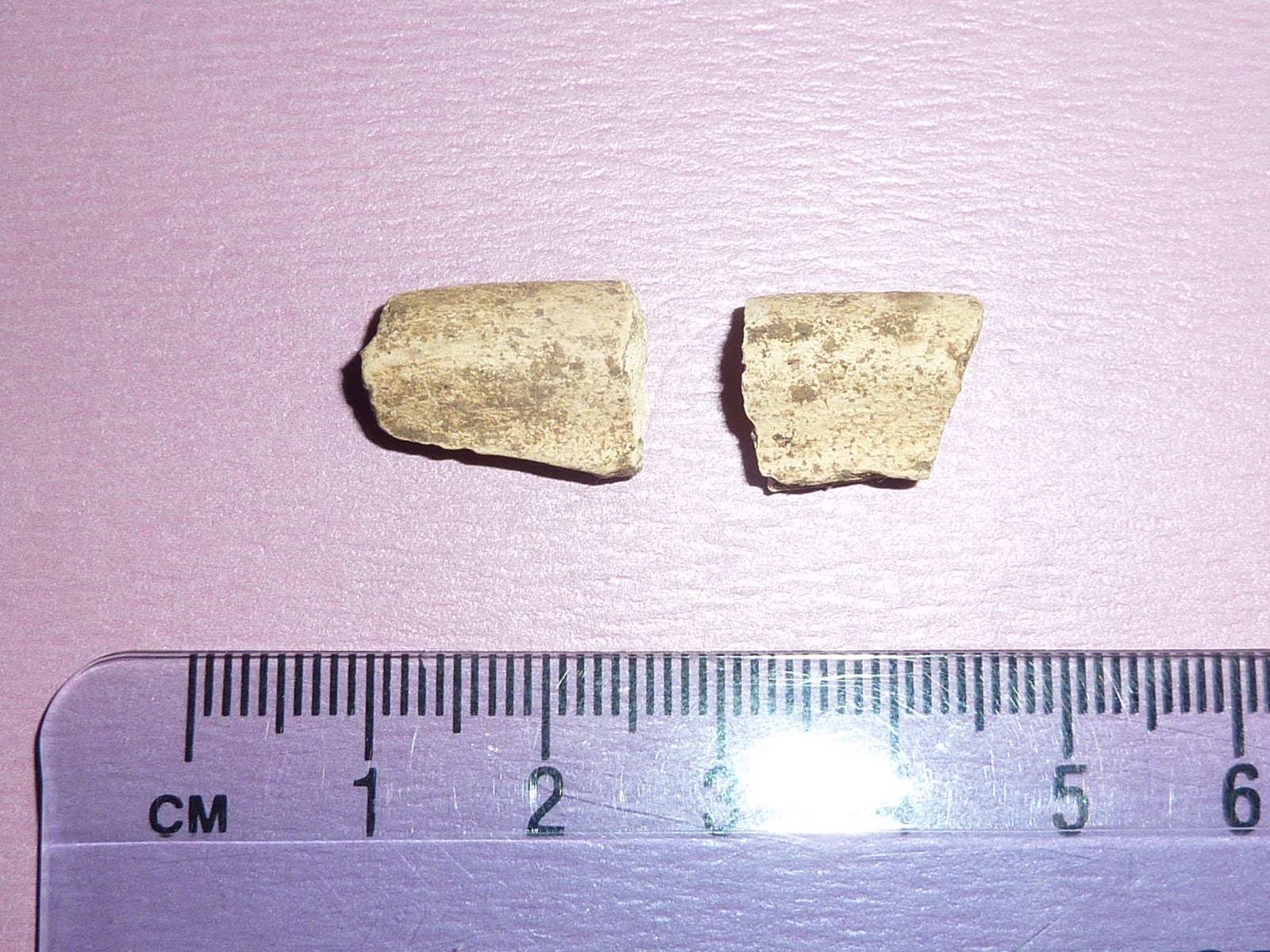
 Oral tradition says this was used as a quarry and despite some promising lumps and bumps this does appear to have been used for stone clearance and later as a midden for the farm. Everything from 19th century bottles and plates to toothpaste tubes were uncovered. However there was one piece of pottery that excited Jane our visiting archaeologist.This unglazed rim from a vessel has tentatively been dated as medieval.


  The days are short just now and our work stops about 3.00pm but the low sun of winter and days of frost and light snow are useful for detecting ancient human activity in the landscape. Here beside where we are working can clearly be seen the green ridges of medieval 'rig and furrow' cultivation.

Rig and Furrow

This weekend we will return to the wood and extend trenches 1&2 and hopefully find some signs of human habitation.

The sun sets and the moon rises over Corehead 


Saturday, 5 November 2011

Archaeology Dig at Corehead


Tomorrow and for the next three successive Sundays in November will see the start of an archaeological excavation to locate the site of Corehead Tower. Many Halliday readers will know that the Dumfriesshire family have long been associated with Corehead. This stems from the legend that Tom Halliday who lived at Corehead was nephew to William Wallace the Scottish guerrilla leader during the Scottish Wars of Independence. The earliest record for this association appears in The Wallace a poem written in Scots by Blind Harry about 1477. Historians and scholars have dismissed much of the poems contents as fiction and yet there are elements within which on closer examination bear some element of truth. This is something I will return to later.


Black and white photos from Clarence Halliday early 1960's book

The poem does not mention a tower or castle only that they stayed at 'the Corhead'.A later Border Ballad called The Sang of the Outlaw Murray also refers to the Halliday family of Corehead. Yet despite searching for many years I have not yet found any charter or reference to a land transaction that connects the family specifically to Corehead.
It is known that the Bruce family were Lords of Annandale from 1124 and later the Douglases were granted the lands of Moffat and Corehead in the 14th century. They held them until the 1550s  when Johnstone of Craigieburn purchased them.This branch of the Johnstone clan then took the title Johnstone of Corehead.They  had other towers at Cornal,Corehead and Lochhouse.   .
The earliest surviving record  of a tower at Corehead  appears in a map of 1597 which depicts the tower at the head of Annandale.


The Johnstone family continued to live at Corehead farmhouse until the late 19th century.


In 2009 the farm and surrounding hill land around the Devil's Beef Tub was purchased by the Borders Forest Trust.

Tomorrow a small team of volunteers and archaeologists will begin the hunt for the tower. The area will need to be cleared of fallen trees and test pits will be dug at promising sites. All very exciting

Saturday, 16 July 2011

New Web Site Launched


Finally after months of planning my new web site http://www.scotlandsgenealogy.com/ has been launched thanks to the team at Evolution Design in Edinburgh. This offers a fully comprehensive range of  family history services. From locating births,marriages and deaths to house histories,photography and transcription of old handwriting.If any of you think there is something or someone I am able to help then please get in contact:

chris@scotlandsgenealogy.com

http://scotlandsgenealogy.blogspot.com/

Twitter: @scotsgen

Thanks


Saturday, 28 May 2011

Halliday Hill

There are two Halliday Hills located in Dumfriesshire: one in Annandale and one in Nithsdale.This photo is the one in Annandale taken on the farm road adjacent to the minor road between Dalton and Dumfries. There is no documented evidence that Hallidays gathered here before going on a raid.

The hill has a commanding panoramic view over Annandale to the Solway Firth and the Border. In the R.C.Reid collection a John Carruthers,Laird of Mousewald obtained a charter from John Halliday of Hoddom on 31 May 1439.This John Carruthers was later Captain of Lochmaben Castle in 1446.Reid was inclined to believe that possibly the name Hallidayhill until recently part of Hoddom estate,is derived from this family- the Hallidays of Hoddom.George Black in his 'Surnames of Scotland' held the same view.

Saturday, 7 May 2011

Arms of Robert Douglas Halliday of Coldbrook,Island of St Croix

Arms of Robert Douglas Halliday Esquire of Coldbrook in the Island of St Croix: Argent a Sword erected in Pale proper hilted and pommelled Or the last within a crescent in base Gules in a dexter Canton Azure a Saltyr of the Field.

Crest:   A Boars head couped Argent armed Or
Motto:  Virtute Parta
28 March 1775

Tuesday, 3 May 2011

Early Map of Corehead :1590

This is a map of the opposite borders of Scotland and England. It is from an atlas that belonged to William Cecil Lord Burghley, Elizabeth I’s Secretary of State. Burghley used this atlas to illustrate domestic matters. This map is interesting because it shows the debatable lands, these were lands between the borders of Scotland and England, claimed by neither and subsequently a lawless no-man’s land. Lord Burghley has annotated the map, adding place names at points along the river which forms part of the border, and the river immediately to the right of this which lies on English soil. The title, "A Platt of the opposete Borders of Scotland to ye west marches of England" appears on the reverse with the date: "Dec. 1590". The original is held in the British Library,London.

 Corehead Tower which was probably built about 1570 was owned by the family of Johnstone of Corehead.The tower was probably on the site of earlier fortifications and perhaps the location for William Wallace meeting his nephew Tom Halliday. The tower on the map is the very top one on the left handside.It is possible to zoom in on the British Library site.  http://bit.ly/jV6ntM

Monday, 2 May 2011

Halliday Heraldry

This is the earliest representation of the Halliday arms recorded in Scotland. They are depicted in a document held in the Court of the Lord Lyon in Edinburgh and originally were in a manuscript known as Workman's MS. This is believed to have been compiled c. 1565.

It shows the saltire of Scotland or St Andrew's Cross,the crescent and sword. Variations of this theme were matriculated by Hallidays in the following centuries.Unfortunately no name is given to who owned these arms.

Saturday, 19 February 2011

Reivers

 On 3 Dec 1541 Sir Thomas Wharton the English Warden of the West March reported to the Privy Council the

Slaughters and cruell murdures commytted and doyn within the Kinges highnes West Marches of England by Scotish men at sundry tymes sithens the begynnyng of the peace,agaynst the trewes as foloweth .


Andro Forster, John Forster, John Gray ,Alan Forster, Jok Haliday, Andro Armstrang Scotishmen comme to Dermaynstedes in Ingland,and there cruelly slewe and murdered Richy Blaikburn Inglishman.’


The same band of individuals appear again for similar cross border forays.

Alane Forster, Gerge Forster, John Haliday, Willy Forster, John Gray and there complices, Scotishmen, to the nombre of XL men, comme to a place in Gilleslond called Kyng and there cruelly slewe and murdered John Crawe, Thomes Crawe and Thomas Crawe younger. (Bain,J. 1890 The Border Papers)

Halliday Border Reivers

I shall post a few extracts from original records of incidents on the Border where individual Hallidays took part. There are no records of the family organised as a fighting unit like the better known Johnstones and Armstrongs.Rather they participated with different Border families both on the Scots and English sides.

In 1554  Donald Halieday was listed for escheat of all gudis  with numerous Johnstones, Bells, Carruthers and Charteris of Amisfield, were denuncit rebellis and put to the horne for coming in the month of August last to the place of William Kirkpatrick of Kirkmichael and there spoiling and away taking of his gudes and geir and cruelly slaying Roger Kirkpatrick, wounding and hurting Robert and Alex Kirkpatrick. (Registrum Secreti)

Saturday, 15 January 2011

A Halliday! A Halliday! Lets Get Organised

Ok,enough procrastination,lets get a proper global communication going between all Hallidays with roots in Scotland and lets see where we share our heritage and family connections. Due to other genealogy commitments I have let this lapse but with the New Year I am determined to get the ball rolling and see what develops. I will continue to post historical,biographical and genealogical stories of interest and will welcome enquiries from others.We have several members of the clan in Australia,NewZealand,Canada and USA who have done a considerable amount of research and now we really need to share that with others.
I am currently writing an MSc thesis  The Fiction of Identity; Has Scottish Literature Invented My Family History ? which takes a close critical examination of the writings of mostly 19th century antiquarians and how they invented what we believe to be the Halliday family history.
How many times have you seen written on the web and in publications that:
  1.  Tom Halliday of Corehead was the nephew of William Wallace
  2.  They had a tower/castle at Corehead
  3. The Halliday family took part in the Crusades
  4. They were Border Reivers
  5. They were Covenanters
  6. The family gathered on Halliday Hill before embarking on a raid into England
  7. The origins of the name from a war cry,Latin,Old English etc
  8. We are descended from Picts,Celts Anglo-Saxons
Hopefully you and I will be able to set the record straight and who knows in the future compile a new up to date publication about our family history and origins. There will be another Clan gathering in Scotland in 2014 and it would be great if we could aim to join this with our other Border neighbours the Moffats and the Johnstons.Plenty to think about so please contribute with your stories and thoughts.
I can be contacted at email  chrisxhalliday@tiscali.co.uk
                             twitter    http://twitter.com/scotsgen

Saturday, 5 June 2010

Dave Halliday of Queen of the South F.C.

Dave Halliday (1901-1970) was one of the most prolific scorers in British football. A native of Dumfries,the 6ft,12st 4lb centre forward was well equipped physically for the position. He played for his hometown team,Queen of the South,Dundee and St Mirren before moving on to play in England for Sunderland, Arsenal, and Manchester City. He scored 375 goals and is among the very few group of players of less than 30 to have scored over 200 goals in English top divisions. As a manager only Halliday and Sir Alex Ferguson have guided Aberdeen to be Scottish champions. He would be a worthy addition to the Scottish Football Hall of Fame. Dave Halliday also had two brothers Billy and John who played for Queen of the South,and Billy went on to be manager of Newcastle United.  

Sunday, 16 May 2010

Lt Gen Sir Lewis Stratford Tollemache Halliday V.C.

From time to time I will add biographies of famous Hallidays. Where better than to start with our only Victoria Cross holder.Lt Gen Sir Lewis Halliday 14/5/1870-9/3/1966 became Adjutant General of the Royal Marines and Honorary Colonel Commandant. He was awarded the V.C. as a Captain in the Boxer Rebellion. He was descended from John Halliday of Castlemains in Kirkcudbright and Antigua.


Citation: On the 24th June, 1900, the enemy, consisting of Boxers and Imperial troops, made a fierce attack on the west wall of the British Legation [at Peking], setting fire to the West Gate of the south stable quarters, and taking cover in the buildings which adjoined the wall.


The fire, which spread to part of the stables, and through which and the smoke a galling fire was kept up by the Imperial troops, was with difficulty extinguished, and as the presence of the enemy in the adjoining buildings was a grave danger to the Legation, a sortie was organized to drive them out. A hole was made in the Legation Wall, and Captain Halliday, in command of twenty Marines, led the way into the buildings and almost immediately engaged a party of the enemy.

Before he could use his revolver, however, he was shot through the left shoulder, at point blank range, the bullet fracturing the shoulder and carrying away part of the lung. Nothwithstanding the extremely severe nature of his wound, Captain Halliday killed three of his assailants, and telling his men to "carry on and not mind him," walked back unaided to the hospital, refusing escort and aid so as not to diminish the number of men engaged in the sortie.


(London Gazette Issue 27262 dated 1 Jan 1901, published 1 Jan 1901.)

Saturday, 24 April 2010

Thursday, 8 April 2010

The Devil's Beef Tub

Here at the head of Annandale in Dumfriesshire and where the River Annan rises, is the natural glacial feature known as the Devil's Beef Tub. Close to here is the farm of Corehead where Tom Halliday met his uncle, William Wallace. Together with a small band of followers they captured Lochmaben Castle from the English. This incident is recorded by "Blind Harry" about 1477 in the famous poem written in Scots, "The Wallace". The deeds of Tom Halliday and his famous uncle took place about 1296 and thus Tom Halliday is the earliest recorded Halliday in Scotland. "The Wallace" contains many historical errors and records events which never happened. Was Tom Halliday a real person or a fictitious character in "Harry's " composition?